

A well-made counterfeit no longer announces itself with peeling logos and crooked stitching. In 2026, the fakes flooding resale marketplaces and social-media storefronts copy the dust bag, the care card, even the serial number - and they do it convincingly enough to fool a casual glance. So the honest answer to how to tell if a Gucci bag is real is that no single detail settles the question. Authenticity lives in the combination: the crispness of the heat stamp, the weight of the hardware, the symmetry of the GG canvas across a seam, the quality of the leather under your fingertips.
This guide walks you through the markers that matter, model by model, so you can shop with the confidence of someone who knows exactly where a fake tends to fall apart. It's the same discipline our specialists apply to every piece that passes through Collector's Cage before it reaches you.
Key takeaways from this guide:
- Never authenticate a Gucci bag from one detail - cross-check the heat stamp, serial tag, hardware, canvas alignment and leather together.
- The interior leather serial tab carries "Gucci" and "made in Italy" on the front and two rows of digits on the back - but the tab's craftsmanship matters more than the number.
- GG canvas and the green-red-green Web stripe should flow symmetrically and logically across every seam and flap.
- Each icon - GG Marmont, Dionysus, Jackie 1961, Horsebit 1955 - has model-specific tells that fakes still struggle to replicate.
- 2026 superfakes copy cards, codes and packaging, so weight physical construction over paperwork.
- Authenticated pre-owned removes the guesswork entirely - every Collector's Cage piece is expert-verified.
The Fast Checklist: How to Spot a Fake Gucci Bag
Before we go deep, here's the 60-second pass. If a bag fails several of these, walk away; if it passes all five, it earns a closer inspection rather than an automatic pass. Learning how to tell if a Gucci bag is real starts with running these checks together, not in isolation.
The five-point at-a-glance check
- Heat stamp: The interior "GUCCI" branding should be crisp, evenly kerned and cleanly pressed - never blurry, shallow or tilted.
- Serial tag: A soft leather tab tucked into an interior seam, with branding on the front and two neat rows of digits on the back. The tab's edges and stitching should be immaculate.
- Hardware weight: Zippers, buckles and feet feel substantial and cool. Cheap, light or hollow-feeling metal is an immediate red flag.
- Canvas symmetry: The GG pattern and Web stripe line up logically across seams and flaps. Interrupted or off-centre motifs betray a fake or a factory shortcut.
- Overall craftsmanship: Even stitch density, supple leather, no glue smell, clean linings. Gucci's finishing is quiet and precise.
A critical warning for 2026: modern counterfeiters now clone serial numbers, dust bags and authenticity cards. A "matching" serial or a convincing box proves very little on its own. Always cross-check multiple markers, never one.


A Brief History of Gucci's House Codes
Guccio Gucci founded the house in Florence in 1921, first as a purveyor of fine leather luggage and equestrian-inspired goods. That heritage isn't just marketing romance - it's why so many of Gucci's motifs double as authentication anchors. When you understand where a code comes from, an inconsistent version becomes far easier to spot.
Where the icons come from
The interlocking GG monogram derives from the founder's own initials and debuted in earnest in the 1960s. The Web stripe - green-red-green, echoing a saddle girth - is one of the most copied and most consistently botched details on fakes. The Horsebit and bamboo handle details, both born of the house's equestrian and mid-century resourcefulness, remain signature hardware cues today.
What unites every genuine Gucci across a century is a through-line of discipline: symmetrical patterns, high-grade leather and precisely finished hardware. Counterfeiters can imitate a logo shape; they rarely sustain that discipline across an entire bag.
Read the era, not just the checklist
Because hardware finishes, serial formats and interior stamps have evolved across decades, any authentication guide must be read against a bag's approximate production year. A detail that's correct for a 2015 Dionysus may look "wrong" on a 1990s vintage piece - and vice versa. Context is part of the craft.
The Core Authentication Markers (Every Gucci Model)
These markers apply across the range, from an Ophidia camera bag to a structured Horsebit 1955. Master them first, then layer on the model-specific details in the next section.
Serial number and heat-stamp tag
Most modern Gucci bags carry a small rectangular leather serial tab stitched into an interior seam or pocket. On the front, expect "Gucci" above "made in Italy"; on the reverse, two rows of embossed digits. Rather than memorising codes - which fakes copy anyway - study the execution: the tab should be evenly cut, cleanly stitched and the embossing should be sharp and legible, pressed into good leather rather than stamped onto stiff, plasticky material.
Heat stamp and font
Gucci's lettering is a reliable tell. On an authentic bag, the "GUCCI" heat stamp shows crisp, evenly spaced characters with consistent kerning - note the twin Cs and the balanced letter weight. Fakes frequently reveal themselves here with lettering that's too thick, slightly blurry, unevenly spaced or pressed at a subtle angle. Hold it in good light and compare the spacing letter by letter.
GG canvas and Web stripe alignment
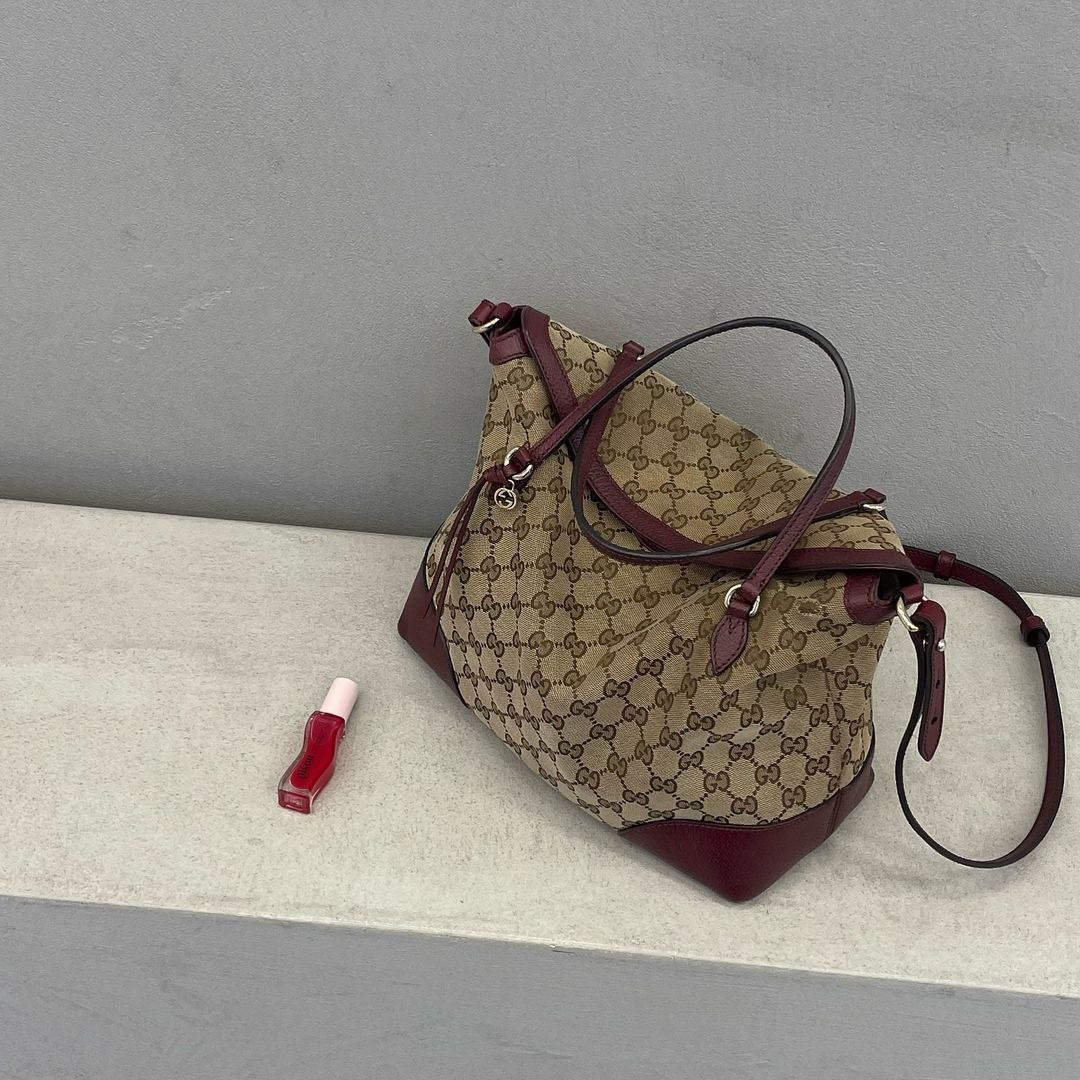
On genuine GG Supreme canvas, the pattern is symmetrical and continues logically across seams, flaps and gussets - the house takes care to centre and align the motif. The Web stripe must read green-red-green in the correct order and proportion. Reversed colours, uneven widths or a stripe that ignores the bag's symmetry are classic counterfeit errors.
Hardware and engravings
Authentic Gucci hardware has real heft. Zippers - often supplied by YKK or Lampo - glide smoothly and frequently carry a discreet "Gucci" engraving on the pull. Feet, buckles and logo plaques are cleanly cast with sharp, legible engraving. Light, rattly or roughly finished metal points to a fake.
Stitching, leather and smell
Look for even stitch count and straight lines with no loose threads. Genuine leather is supple and smells like leather - never of chemicals or glue. Interior linings, whether cotton or the microfiber suede used in many Marmont styles, should feel considered and consistent, not thin or scratchy.
Interior labels and the controllato tag
Beyond the serial tab, many Gucci bags include a small "controllato" quality-control tab - typically a plain slip indicating the piece passed inspection. Its presence and clean finishing are supporting evidence, but like every marker, it should confirm rather than replace the others.
Model-by-Model: The Details That Trip Up Fakes
Each Gucci icon carries fingerprints of its own. If you know what to press on, you'll spot the shortcut a counterfeiter took to save time or money.
GG Marmont
The Marmont's chevron matelassé quilting is a giveaway. On an authentic bag the chevrons meet cleanly at the centre and align symmetrically down the flap and along the seams. The oversized antique-gold double-G logo should have a correct shape and depth - genuine versions read as slightly aged, not brassy. Flip the bag over and check the small heart-shaped stitching on the back, a detail fakes often render sloppily. Finally, the chain strap should feel weighty and hang smoothly. For sizing context, our GG Marmont size guide is a useful companion.
Dionysus
The Dionysus is defined by its tiger-head (Bacchus) closure. Examine the enamel or antiqued finish and the crispness of the casting - the two heads should be detailed and symmetrical. The chain slides to open the bag without a clasp, and that mechanism should operate smoothly. Check the suede or canvas construction, the interior finishing and the neat back slip pocket; counterfeit Dionysus bags typically cut corners on the hardware detail and the suede quality.
Jackie 1961
The reissued Jackie hinges on its piston-hook closure. On a genuine bag the hook engages with a precise, satisfying action and carries clean engraving. The hobo silhouette should sit correctly, the strap should adjust smoothly, and the hardware overall is minimal and immaculate. Fakes often get the piston mechanism feeling loose, rattly or vague.
Horsebit 1955
Here the horsebit hardware is everything: the casting should be clean, the finish even, and the piece solidly weighted. Assess flap alignment, the structured shape holding its form, and the leather grain, which should be uniform and high-grade. A soft, floppy body or a lightweight, roughly finished horsebit points to a counterfeit.
Ophidia
The Ophidia's GG Supreme canvas has a distinctive soft hand-feel - genuine versions are pliable but never cheap-feeling. Check the Web stripe placement and the round logo detail, both of which fakes tend to misalign. Because the Ophidia sits at Gucci's more accessible price point, it's also a magnet for suspiciously cheap listings; a rock-bottom price should raise your guard rather than your enthusiasm.
Spotting 2026 Superfakes
The counterfeit landscape has shifted. The best fakes now reproduce serial tags, QR and care cards, dust bags and even boxes with unsettling accuracy. Paperwork alone no longer proves anything.
Where superfakes still fail
The good news is that convincing packaging rarely comes with convincing construction. Superfakes still stumble on the details that require genuine craftsmanship and time:
- Interior stitch consistency - uneven density and tension inside where makers assume no one looks.
- Hardware weight and engraving depth - the metal is lighter, the engraving shallower.
- Canvas symmetry across seams - the pattern breaks or shifts where an authentic bag flows.
- Leather aging and smell - chemical odours and stiff, over-uniform "leather" that won't patina naturally.
Price as a red flag
Knowing rough retail ranges helps a "too good to be true" listing stand out. These are approximate 2026 figures for popular models:
| Model | Approx. retail (new) | Typical pre-owned range* |
|---|---|---|
| GG Marmont Small (shoulder) | €2,400 (~$2,600) | €1,100-€1,800 |
| Dionysus Small | €2,700 (~$2,950) | €1,300-€2,100 |
| Jackie 1961 Small | €2,900 (~$3,150) | €1,500-€2,400 |
| Horsebit 1955 Shoulder | €2,900 (~$3,150) | €1,400-€2,300 |
| Ophidia GG Small | €1,500 (~$1,650) | €700-€1,150 |
*Pre-owned ranges vary with condition, colour and completeness; treat these as approximate guidance, not fixed quotes.
If a "brand new" Marmont is offered at a fraction of these figures, the listing is almost certainly counterfeit - no legitimate seller loses that much money on an in-demand icon.
The receipt and serial fallacy
Cards, receipts and codes are the easiest elements to fake, precisely because they're paper and pixels rather than leather and metal. Weight the physical construction above all - and where a purchase matters, rely on professional authentication. If you cross-shop houses, the same principle carries over; our Chanel authentication guide and Dior guide apply the same construction-first discipline.
Buying Pre-Owned Gucci With Confidence
Once you understand how fragile paperwork is and how demanding true authentication has become, the appeal of buying from an expert-verified source becomes obvious. Pre-owned isn't a compromise - for many collectors it's the smarter path.
Why authenticated pre-owned makes sense
Gucci's icons hold their value well. A GG Marmont or Jackie 1961 bought pre-owned typically costs meaningfully less than retail while retaining strong resale demand. Buying pre-owned is also the sustainable choice, extending the life of beautifully made objects, and it's often the only way to access discontinued colours and finishes that never return to the boutique.
How Collector's Cage works
Every bag we sell is expert-authenticated before it's listed, and each piece is a genuine one-of-one - the exact bag in the photographs is the bag you receive. New arrivals are added weekly, so the Gucci collection refreshes constantly across Marmont, Dionysus, Jackie, Horsebit and Ophidia styles. If you shop across houses, you'll find the same standard applied to our Louis Vuitton, Chanel and Prada selections.
That authentication rigour is backed by our authenticity guarantee, so you can focus on choosing the bag rather than second-guessing the seller. And if you'd like to know the people behind the process, our team introduces itself on the About Collector's Cage page.
A quick comparison: sources for buying pre-owned
| Source | Authentication | Risk level |
|---|---|---|
| Peer-to-peer marketplace | None guaranteed | High |
| Social-media seller | Self-declared | Very high |
| Generic resale platform | Variable | Medium |
| Specialist boutique (e.g. Collector's Cage) | Expert-verified, guaranteed | Low |
Frequently Asked Questions
How can I check a Gucci serial number?
Locate the interior leather serial tab and read the two rows of embossed digits on its reverse, then assess whether the tab itself is cleanly cut, well stitched and sharply embossed on quality leather. There is no reliable public database to "verify" a Gucci serial online, and counterfeiters copy numbers directly, so treat the serial as one supporting marker among many rather than proof on its own.
Does a real Gucci bag always come with a dust bag and card?
Most new Gucci bags ship with a dust bag and controllato/care card, but pre-owned and vintage pieces often arrive without their original packaging, and that alone doesn't make them fake. Because fakes now include convincing packaging too, the presence or absence of a dust bag and card should never be your deciding factor - the construction always outranks the paperwork.
Where is the serial number located on a Gucci bag?
It's usually on a soft leather tab stitched into an interior seam or the inside of a pocket, rather than printed on the lining. The exact placement varies by model and production era, so on vintage pieces you may need to feel along the interior seams. If a tab is glued flat, stiff or crudely attached, that's a warning sign in itself.
Can Gucci fakes have real-looking serial numbers in 2026?
Yes - this is exactly why serial numbers can no longer authenticate a bag on their own. Superfakes routinely replicate plausible serial formats, cards and even QR codes. Focus instead on hardware weight, engraving depth, canvas symmetry across seams, stitch consistency and leather quality, which are far harder to fake convincingly.
How can you tell a real GG Marmont from a fake?
Check that the chevron quilting aligns symmetrically at the centre and along the seams, examine the antique-gold double-G logo for correct shape and depth, and inspect the small heart stitching on the back for clean execution. Then confirm the chain feels weighty and the heat stamp is crisp. A fake usually fails at least one of these, most often the quilting alignment or the logo finish.
Is buying pre-owned Gucci safe?
It's very safe when you buy from a specialist that authenticates every piece and stands behind it with a guarantee. The risk lies in unverified peer-to-peer and social-media listings, where superfakes are common. At Collector's Cage, each Gucci bag is expert-authenticated and sold as a one-of-one, so the guesswork is removed before the bag ever reaches you.


