

Learning how to tell if a Louis Vuitton Keepall is real has become an essential skill for anyone shopping the secondary market in 2026. The Keepall is Louis Vuitton's most iconic - and most counterfeited - travel bag, which means the fakes range from laughably crude to unnervingly convincing. Whether you are eyeing a vintage Monogram duffle or a current-era Keepall Bandoulière, knowing what to look for protects both your money and your peace of mind.
The good news: authenticating a Keepall follows a logical, repeatable process. No single detail proves a bag is genuine, but the right combination of signals - canvas alignment, leather, hardware, stamps and internal construction - tells a clear story. This guide walks through each step for both date-code and microchip eras, and shows you where even the best 2026 superfakes still slip.
Key takeaways from this guide:
- Authenticity is confirmed by a combination of signals, never a single tell.
- Monogram symmetry, warm gold canvas tone and even vachetta patina are your first filters.
- Pre-2021 Keepalls have a stamped date code; newer bags use an embedded RFID microchip with no visible code.
- Heat-stamp font weight, zipper feel and interior finishing expose most superfakes.
- After the May 2026 retail increase, authenticated pre-owned offers the strongest value.
- For high-value purchases, buying from an authenticated seller removes the guesswork entirely.
Why Keepall Authentication Matters More Than Ever in 2026
The Keepall sits at the intersection of everything counterfeiters love: high demand, strong resale, and a design instantly recognisable across the world. That popularity makes it the single most-copied travel silhouette Louis Vuitton produces, and the reproductions have grown more sophisticated every year.
The May 2026 retail price increase pushed a new wave of buyers toward the pre-owned market, where a well-kept Keepall can offer excellent value - but only if it is genuine. That shift means authentication skill is no longer optional. More transactions between private buyers and sellers means more opportunities for a convincing fake to change hands.
This guide is designed to work for both vintage bags and current-era models. The methods differ slightly by era - especially around date codes versus microchips - but the underlying discipline is the same. Read every signal, weigh them together, and trust the pattern rather than any single feature.
Keepall at a Glance: Models, Sizes & Materials
The Keepall first appeared in the 1930s as Louis Vuitton's answer to modern, lightweight travel - a soft-sided duffle that could be packed easily and carried by hand. Over the decades it evolved into the refined travel bag collectors know today, offered in a range of canvases and, more recently, embossed leathers.
Keepall vs. Keepall Bandoulière
The standard Keepall is a hand-carried duffle with rolled handles and no shoulder strap. The Keepall Bandoulière adds a detachable, adjustable shoulder strap plus a leather luggage tag and, typically, a clochette (the small pouch that holds the padlock keys). If a listing calls a bag a Bandoulière but shows no strap or tag, ask why.
Sizes and typical use
| Model | Approx. length | Best for |
|---|---|---|
| Keepall 45 | ~45 cm | Weekend / cabin-friendly carry-on |
| Keepall 50 | ~50 cm | Short trips, most popular all-rounder |
| Keepall 55 | ~55 cm | Longer trips, generous packing |
| Keepall 60 | ~60 cm | Extended travel, largest classic size |
Common materials include classic Monogram and Damier Ebene coated canvas, the darker Damier Graphite and Monogram Eclipse in the men's line, and softer Monogram Empreinte embossed leather. Knowing which materials LV actually produces is itself an authentication tool - an unusual "exclusive" colourway that never existed at retail is a warning sign.


Step 1: Read the Monogram and Canvas Alignment
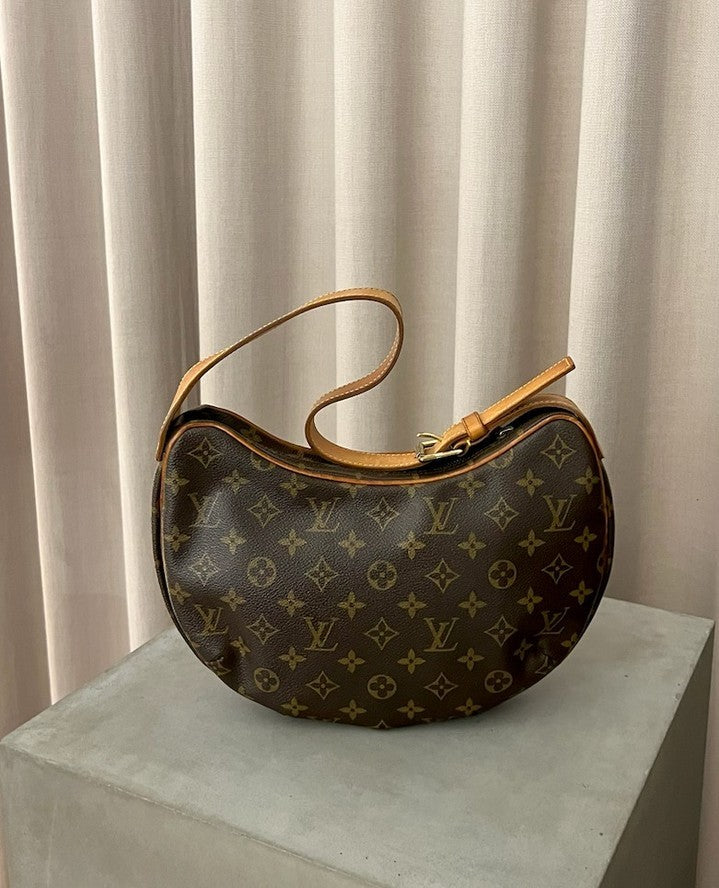
Louis Vuitton treats monogram placement as a point of pride. On a genuine Keepall, the pattern is centered and mirrored across the seams, so the two sides of the bag read symmetrically. Counterfeiters often cut corners on canvas usage to save fabric, producing off-centre or mismatched patterns.
Symmetry and letter placement
The LV letters and flowers should never be awkwardly chopped at high-attention areas. Genuine placement is deliberate: the monogram flows cleanly across the front, the sides mirror one another, and the base repeats the pattern in an orderly way. Check both sides and the bottom - symmetry across all three is a strong first filter.
Canvas texture and colour
Authentic coated canvas feels smooth and firm, not plasticky or overly glossy. A cheap, shiny, rubbery surface is a giveaway. The monogram itself uses a warm mustard-gold tone; fakes tend to run either too yellow (almost neon) or too brown and muddy. Compare against verified reference images if you have any doubt about the colour.
Step 2: Leather Trim, Patina & Heat Stamp
The vachetta leather trim is one of the most revealing parts of a Keepall. Untreated when new, genuine vachetta starts pale and develops an even honey-to-caramel patina over years of handling and light exposure. Patina that looks blotchy, artificially darkened, or suspiciously uniform on an otherwise "new" bag is a red flag.
The heat stamp
On the leather tab you should find "LOUIS VUITTON" above "made in" and the country of manufacture (France, Spain, USA, Italy). The font is thin, refined and evenly spaced, and the stamp is pressed cleanly - never gouged too deep, blurry, or crooked. Counterfeit stamps frequently look heavy, uneven, or use a subtly wrong letter shape.
Handles, stitching and smell
The rolled vachetta handles should feel firm, with tight, even, symmetrical stitching. Real leather has a distinct natural smell; superfakes often carry a chemical or plastic odour that lingers. Trust your nose alongside your eyes - it is a signal that is hard for counterfeiters to fake.
Step 3: Hardware, Zippers & Padlock
Hardware is where quality asserts itself. A genuine Keepall uses solid brass hardware with an even, durable golden finish that resists flaking. Fake hardware often feels light and tinny, and the plating wears quickly, revealing a different metal beneath.
Zippers
Zippers should be heavy and smooth, gliding without catching. Depending on the era, genuine bags may use YKK zippers or LV-branded pulls; the engraving on those pulls is crisp and precise. A rough, rattly zipper that snags is a warning sign.
The padlock
The brass padlock is engraved with "Louis Vuitton" and carries a stamped number, paired with matching numbered keys. The padlock number does not need to correspond to anything on the bag - but the engraving must be sharp and clean. Blurry or shallow engraving points to a replica.
| Feature | Genuine Keepall | Common fake |
|---|---|---|
| Zipper feel | Heavy, smooth, no snag | Light, rough, catches |
| Hardware weight | Substantial brass | Tinny, hollow feel |
| Plating | Even, durable gold tone | Flakes, uneven colour |
| Padlock engraving | Crisp, precise | Blurry, shallow |
| Pull engraving | Clean, refined font | Uneven spacing |
Step 4: Date Code vs. Microchip - Authentication by Era
This is the step most people get wrong, because the correct answer changed. What proves authenticity depends entirely on when the bag was made.
Pre-2021: the stamped date code
Keepalls produced before roughly 2021 carry a stamped date code - usually two letters followed by four digits. The two letters identify the manufacturing factory; the four digits encode the week and year of production. This code is embossed discreetly, often inside the bag or on a hidden leather tab.
To decode the modern format: the first and third digits give the week, and the second and fourth give the year. For example, a code ending in 1189 would read as week 18 of 2019. The code should be pressed cleanly into the leather, not stamped on a separate tag that looks glued in.
2021 onward: the RFID microchip
From around 2021, Louis Vuitton phased out date codes and replaced them with an embedded RFID microchip. These bags have no visible date code at all. This is the single most important era fact: a genuinely new Keepall with a printed date code is a red flag, while a recent bag with no visible code is completely normal.
For a deeper walkthrough of decoding every era, our companion guide on the Louis Vuitton date code vs. microchip is worth reading before any purchase. It covers exactly which years the transition affected and how to read the older codes precisely.
Step 5: Stitching, Interior & Construction
Once the exterior checks out, the interior and overall build often reveal the truth. Louis Vuitton's construction standards are high and consistent - something counterfeiters struggle to match at scale.
Stitching
Look for an even stitch count with consistent tension throughout. LV stitching is regular and slightly angled in a way that repeats identically along seams. Wandering, uneven, or loose stitches - especially near the handles and trim - indicate a lesser bag.
Interior and structure
Depending on the era and line, the lining may be canvas or a soft microfibre. The finishing should be clean, with no loose threads, glue residue, or raw edges. A genuine Keepall feels substantial and holds its shape when handled, even in the soft-sided models. On bags with base studs, those studs should be evenly placed and firmly set.
This construction quality is precisely what separates a good fake from a great one. The best replicas nail the exterior appearance but fall short on the tiny finishing details that Louis Vuitton's ateliers get right every time.
Spotting 2026 Superfakes: Where the Best Replicas Slip
The reality of 2026 is sobering: top-tier superfakes now reproduce the monogram accurately and even claim to include a microchip. That means single-point checks are no longer enough. You must weigh the full combination of signals.
Where they still fail
- Patina consistency - artificial ageing rarely looks as natural as genuine vachetta.
- Heat-stamp font weight - subtle thickness and spacing errors persist even in good fakes.
- Zipper feel - the weight and glide of genuine hardware is hard to replicate.
- Interior finishing - loose threads and imperfect edges give the game away.
Be especially cautious of any listing that promises the bag "comes with everything" - box, dust bag, receipt, cards - as a substitute for the bag itself passing inspection. Papers are the easiest thing to fake. A microchip claim that cannot be independently verified through Louis Vuitton means nothing on its own.
The risk math is simple: modern replicas are convincing enough that DIY checks alone are no longer safe for a four-figure purchase. If you are spending Keepall money, the smartest move is to let a professional stand behind the authentication. The same principle applies across brands - our guides to spotting a real Louis Vuitton Neverfull and authenticating a Goyard bag reach the same conclusion.
Buying an Authenticated Pre-Owned Keepall
After the May 2026 retail increase, the case for pre-owned is stronger than ever. A well-kept Keepall on the secondary market often delivers the same iconic bag at a meaningful saving, and certain vintage configurations are no longer available at retail at all. Availability and value both favour the informed pre-owned buyer.
Why authenticated matters
At Collector's Cage, every Louis Vuitton piece is authenticated before it is listed, each item is a genuine one-of-one, and new arrivals land weekly. That combination lets you shop with the confidence that the hardest part - verifying the bag is real - has already been handled by experts. You can read more about how we work in About Collector's Cage.
If you love the Keepall's travel spirit but want to explore alternatives, it is worth browsing adjacent houses too - the travel and duffle-style offerings across Gucci, Prada, Fendi and Bottega Veneta each carry their own character.
What to ask a private seller
If you do buy privately, request clear, well-lit photos of: the heat stamp, the date code area (or confirmation of a chip-era bag), the zipper pulls and padlock engraving, the interior lining, all four corners, and the base. Ask about the bag's history and where it was purchased. Vague answers, reluctance to photograph specific details, or pressure to complete the sale quickly are all reasons to walk away.
Ultimately, the safest route for a significant purchase is a seller who backs authenticity in writing. That guarantee turns a stressful gamble into a confident acquisition - which is exactly the point of doing the homework in this guide.
Frequently Asked Questions
Do all real Louis Vuitton Keepalls have a date code?
No. Keepalls made before roughly 2021 carry a stamped date code, but from around 2021 onward Louis Vuitton replaced date codes with an embedded RFID microchip and no visible code. A genuinely new Keepall with a printed date code should raise suspicion, while a recent bag without one is entirely normal.
How can I tell a Keepall's age from the date code?
In the modern format, two letters identify the factory and four digits encode the production date. The first and third digits give the week; the second and fourth give the year - so a code ending in 1189 means week 18 of 2019. Older bags used different formats, which our date code vs. microchip guide explains in full.
Where is the microchip located on a newer Keepall?
The RFID chip is embedded discreetly within the bag's construction and is not visible or removable. You cannot see it, and it can only be read with the right equipment - it is not something you can verify at home with a phone. Its presence alone does not prove authenticity.
Can a fake Keepall have a real-looking microchip?
Some superfakes claim to include a chip, but a chip that cannot be verified through Louis Vuitton proves nothing. Never treat a microchip claim as a standalone guarantee. Weigh it against every other signal - canvas, leather, hardware, stitching and finishing - and when in doubt, rely on professional authentication.
Is a lighter or heavier Keepall a sign of a fake?
Weight alone is not conclusive, but a genuine Keepall feels substantial thanks to solid brass hardware and quality canvas. A bag that feels suspiciously light and tinny, especially at the zippers and padlock, is a common warning sign. Consider weight as one clue within the full combination.
Is it safe to buy a pre-owned Louis Vuitton Keepall online?
Yes, when you buy from a seller that authenticates every piece before listing it. Purchasing from an authenticated specialist removes the guesswork and protects your investment far better than private sales. At Collector's Cage, each Keepall is verified, one-of-one, and backed by our authenticity commitment.


